 gem
Map Regions and Camps
gem labels positions with a region (gem.region_of) and farmed camps with a
camp from its catalog. Farming routes use the camp catalog, and the Roshan
records use the regions to count forward wards.
This page shows both on the 7.41 map, and how each was checked against the
replays.
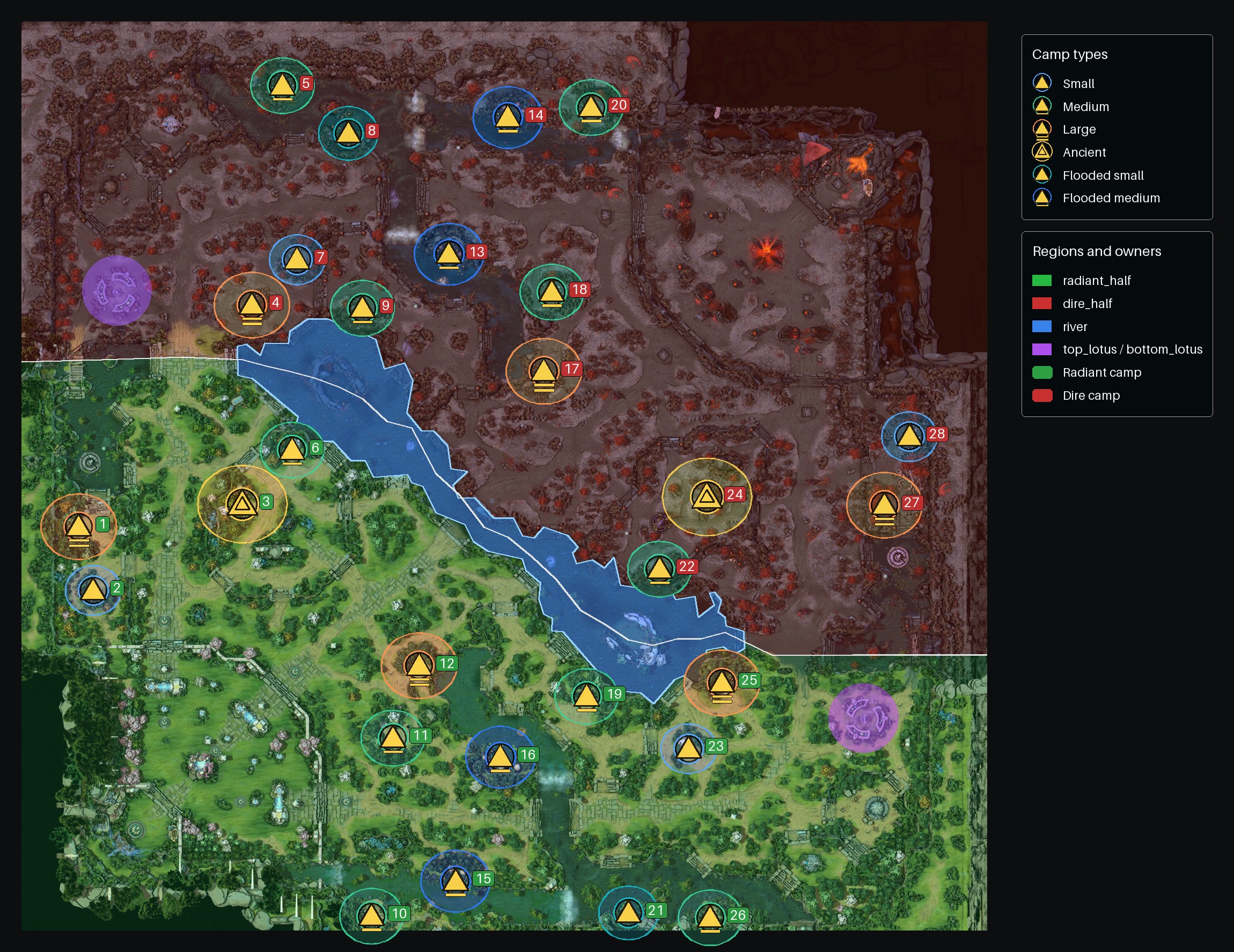
Every point is placed with the same projection as the recipe figures
(gem.catalog.map), which was fitted to replay landmarks (fountains, ancients, lotus pools, wisdom shrines
and outposts) to within about 60 world units.
Regions
gem.region_of(x, y) returns one of five labels (gem.MAP_REGIONS lists them):
| Region | Where |
|---|---|
river | The river's water between the top-lane and bottom-lane crossings, including both Roshan pools. The lanes are not river. |
radiant_half / dire_half | Either side of the half line, which runs along the river's middle and, past its ends, straight out to the map edges. |
top_lotus / bottom_lotus | 700 units round each lotus pool. Both teams contest these from their lanes, so they belong to neither half. |
The river outline is traced from the water in the map image
(scripts/trace_river_region.py); the lotus areas are centred on the replay's
CDOTA_BaseNPC_LotusPool entities. Tests pin the regions to replay entity
positions: both fountains and ancients and both mid tier-one towers are in their
own half, and both power-rune spawners, both Roshan pits and the Roshan spawner
are in the river.
For example, the share of each hero's sampled positions spent in the river:
from collections import Counter

import gem

match = gem.parse("replay.dem")
for player in match.players:
    regions = Counter(gem.region_of(x, y) for _, x, y in player.position_log)
    print(player.hero_name, regions["river"] / max(regions.total(), 1))
Neutral camps
camp_zones.json lists every patch's 28 camps. Each camp's centre is its
CDOTA_NeutralSpawner entity, and its zone is the ellipse for its type. On each
patch, each side owns 14 camps with the same mix:
| Type | Per side |
|---|---|
| Small | 2 |
| Medium | 5 |
| Large | 3 |
| Ancient | 1 |
| Flooded small | 1 |
| Flooded medium | 2 |
Types come from the replays, checked two ways on the 9 local fixtures:
- the spawner's
m_Typewhen it is created (0 small, 1 medium, 2 large, 3 ancient; flooded camps report their starting tier and change it as they evolve); - the creeps that actually spawn there, matched to camp compositions on Liquipedia's Neutral Creeps page. A large camp spawns Hellbears, Wildwings, Trolls, Warpines or the large Centaur and Satyr groups; a medium camp only ever spawns the medium groups.
Liquipedia's camp table still shows the older layout (10 large and 4 ancient camps). Its changelog has the 7.40 and 7.41 demotions that the replays and the catalog follow: ancients by the stream ends and some large camps became medium camps, and the medium camps by the offlane gates became small camps. The flooded camps by the bounty runes (13 and 16) can evolve into ancient frog camps; the other two stop at large.
Patches. 7.42 moved four camps toward the map's rims: both small flooded
camps (8 and 21 on 7.41, 30 and 31 on 7.42) and two medium camps (5 and 26 on
7.41, 29 and 32 on 7.42), the mediums to where the Twin Gates stood. Each
position keeps its own ID, and a camp that exists on some patches only lists them
in patches; gem.catalog.camps_on_patch("7.42") gives one patch's 28. gem never
guesses a replay's patch: a replay's creeps are matched to the camp at their
spawner, and the farming routes use the camps whose spawners produced creeps.
Owners come from the combat log. Each neutral death carries the game's
neutral_camp_team, and every death at a camp carries the same value. All 28
camps agree with it except camp 22: it sits in Dire jungle, and the catalog
follows the terrain, which keeps the two sides mirrored, while the game files it
under Radiant.
Regenerating
# The picture on this page (--patch 7.42 draws 7.42's camps on the 7.42 map)
uv run python scripts/render_camp_zones_overlay.py --regions --width 1800 \
    --margin 40 --legend-panel 420 --output docs/public/map-annotations.jpg

# Re-trace the river from the map image (needs OpenCV)
uv run --with opencv-python-headless python scripts/trace_river_region.py --check
A map patch that moves the river or the camps needs a new map image, a new trace,
and new spawner positions; tests/test_camp_zones_integration.py checks each
patch's camp centres, types and owners against a replay from that patch.