Web UI
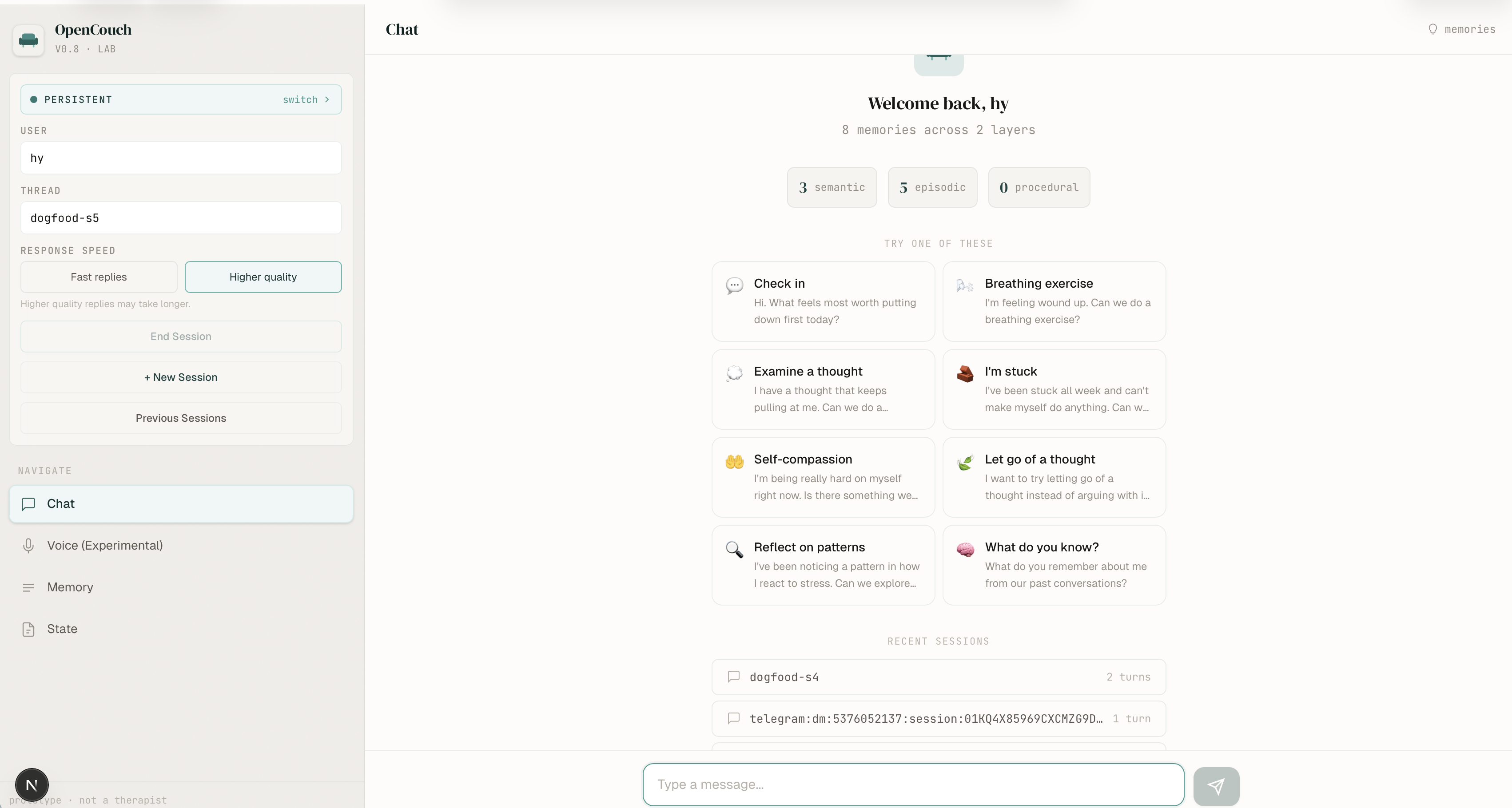
The web app in apps/web is the main browser surface for OpenCouch.
It uses Next.js 16, React 19, Zustand for client session state, and
FastAPI for the backend contract.
Local development
For day-to-day web work, run the Compose backend stack and the frontend dev server separately:
# Terminal 1: Postgres + FastAPI backend on http://localhost:8080/api
./scripts/dev_api_stack.sh

# Terminal 2: Next.js frontend with hot reload
cd apps/web
NEXT_PUBLIC_API_URL=http://localhost:8080/api pnpm dev
Open http://localhost:3000.
The web service is also available in Compose for production-built smoke tests:
./scripts/dev_full_stack.sh
# or: docker compose --profile web up
If you run the backend manually on port 8000, the frontend default
NEXT_PUBLIC_API_URL=http://localhost:8000/api works without extra
configuration.
Session setup
Every load opens a landing screen that gates the app on an explicit choice of memory mode, user id, and thread id. The session lives in the Zustand store and is re-derived on each rehydration, so there is no implicit "resume where you left off" — the user picks how the next session behaves.
- Persistent loads memory and chat history; a blank user id falls back to
web-user, and a blank thread id is auto-generated asweb-<8 char base36>. - Incognito stores nothing: the user id is cleared and a fresh thread id is generated every time.
memory mode is a first-class web concept, not just a backend flag — it gates
client behavior throughout. In incognito the app skips history, memory, and
thread-list fetches and shows "nothing saved" copy; persistent voice shares the
same memory owner as text, while incognito voice writes nothing.
Runtime shape
| Area | Current implementation |
|---|---|
| Text chat | WebSocket streaming through /api/chat/stream, with REST /api/chat available for synchronous turns |
| Session state | Zustand store persisted to local storage for setup-prefill choices: user id, memory mode, model tier, and assistant voice. Thread id is intentionally not persisted — it is regenerated each session to avoid stale thread IDs bleeding across mode switches |
| Thread history | REST calls to /api/threads, /api/threads/{thread_id}/history, and /api/threads/{thread_id}/session-status |
| Memory controls | REST calls under /api/memory/* for status, recall toggle, list, and deletes |
| Voice | OpenAI Realtime WebRTC through /api/voice/realtime/*, with app-owned tool calls, turn recording, and session finalization |
| Debug state | /state calls /api/threads/{thread_id}/state for raw developer inspection only |
| Error handling | Route error.tsx, global-error.tsx, loading fallback, not-found fallback, structured API errors, and visible REST error notices |
Memory page
The /memory route is the user-facing memory manager. It is organized into
four tabs, each with a live count:
- Overview — count cards for facts, sessions, and rules (clicking a card jumps to its tab), a config card (mode, owner, crisis-log and feedback counts), and a proactive-recall toggle.
- Facts — semantic facts with category filter pills; each card has an inline two-step "forget" button.
- Sessions — episodic session arcs on a timeline whose node color reflects the closing mood, with theme tags and a mood-progression chip.
- Rules — procedural style rules with their supporting evidence.
The tab counts come from /api/memory/status; per-card deletes call the
matching /api/memory/* endpoint. The tabs map to the three memory layers —
see Memory overview.
Slash commands
The chat composer accepts a small set of web slash commands, distinct from the
much larger TUI command set. Anything not in this list (including destructive
commands like /memory forget) returns an "unsupported" reply that points the
user to the right surface.
| Command | Effect |
|---|---|
/help | Show the command list |
/end | End the current persistent session |
/new | Return home for a new session |
/threads | Browse previous sessions |
/memory | Open the Memory page |
/memory recall on / off | Toggle proactive recall |
/state | Open the State Inspector |
/chat | Return to chat |
/response-tier fast / quality | Switch response model tier |
Streaming lifecycle
Each chat turn opens one WebSocket connection, sends a single
ChatRequest, renders status/chunk/done messages, and then closes
the socket. The client tracks the active socket in a ref, closes it
on unmount or thread change, and ignores stale stream events when a
newer turn has started.
The stream protocol is:
{"type": "status", "stage": "loading memory", "detail": ""}
{"type": "chunk", "text": "That sounds heavy."}
{"type": "done", "response": {"response_text": "..."}}
{"type": "error", "code": "agent_turn_failed", "message": "The turn could not be completed."}
Malformed stream frames are handled as protocol errors so the UI can
surface a retryable failure instead of crashing the page. Backend
error events are terminal and are surfaced as chat notices.
Debug boundary
The /state route is a developer State Inspector. It displays raw
runtime state from /api/threads/{thread_id}/state, including transcript,
safety, memory, routing, and diagnostics fields. This helps local
dogfooding and debugging, but it is not the product API surface. Normal
UI flows should consume typed chat, history, session-status, memory, and
voice endpoints.
A lighter-weight surface sits inline in the chat: each assistant message
carries an expandable State Strip showing that turn's routing pills
(response style, therapeutic approach, safety level) and timing, drawn from the
diagnostics returned with the reply. It is per-message and always present,
whereas /state is a per-thread raw dump from a separate endpoint.
Voice boundary
The Realtime voice connection needs a client-side provider because the
browser owns WebRTC audio and data-channel events. The app lazy-loads
the provider and mounts it when the user is on /voice, while a voice
session is connected, or while voice finalization is still in progress.
The provider keeps OpenAI audio transport out of the normal text-chat
bundle while keeping transcripts, tool activity, and memory finalization
in the shared Zustand session store.
The production voice route is /voice. A lower-level dogfood route,
/voice/realtime-dev, uses the same connectRealtimeVoiceSession(...)
client helper but exposes raw and parsed Realtime events for debugging.
The provider is intentionally separate from the text streaming path:
| Text chat | Voice |
|---|---|
Opens /api/chat/stream WebSocket for one user turn. | Opens WebRTC directly to OpenAI Realtime with an ephemeral client secret. |
Backend runs run_turn_stream(...). | Backend creates config, executes tools, records finalized turns, and finalizes sessions. |
| Streaming status comes from runtime stages. | UI status comes from Realtime connection state, transcript events, tool activity, and finalization status. |
Verification
Run these checks from apps/web:
pnpm lint
pnpm build
The repository CI runs both commands for apps/web so frontend
regressions fail before merge.